Can agriculture 4.0 technology adoption reduce agricultural expansion in sub-Saharan Africa?
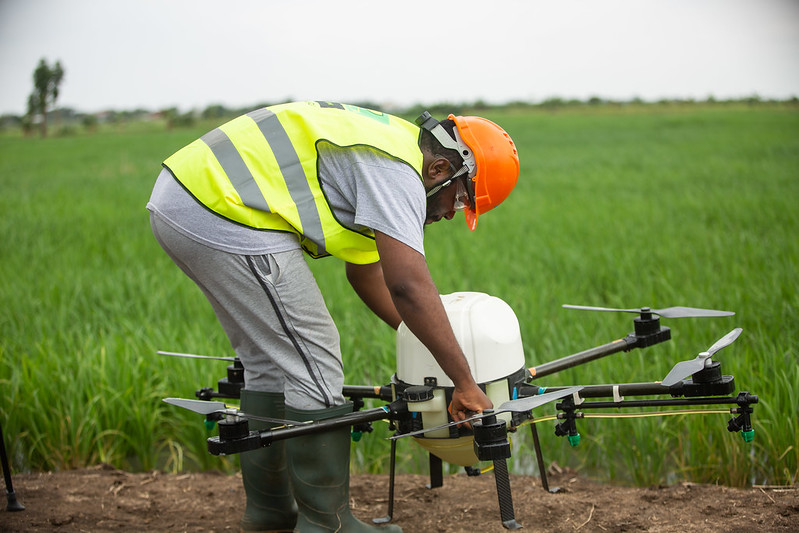
On field drone demonstrations at the Kpong irrigation scheme in Ghana. Photo by: CTA ACP-EU via: Flickr. CC BY-SA 2.0
Conversations around how to ensure sufficient food for the growing sub-Saharan African (SSA) population are driving discussions among agricultural policy makers on how to promote food self-sufficiency. These conversations coincide with a rapid rate of forest depletion across much of the continent, with research and on-the-ground evidence pointing to agricultural expansion as a key driver of forest loss.
A shift in production processes through technology application that incorporates precision farming, the internet of things (IoT), cloud computing, big data, drones, biotechnology innovations, smart farming, and robotics – broadly referred to as agriculture 4.0 – is being witnessed across the globe. Research to date tends to emphasise the use of this suite of technologies from a high-income country (HIC) perspective, with less attention to its relevance in low- and middle-income countries (LMICs).
Yet there is considerable scope for the application of agriculture 4.0 technologies to enable farmers to produce more on existing land in a sustainable way, consequently reducing the expansion of agricultural land to feed the continent’s population, as is common in SSA. However, just as was the case with the Asian Green Revolution, it is not certain whether SSA will tap into this new wave of technology that has the potential to lead to the production of more food per unit area. In our perspective paper, we ask this pertinent question: “Is sub-Saharan Africa ready for the new wave of agriculture 4.0 revolution”. Tackling this question could prove to be game-changing.
Is sub-Saharan Africa ready?
We looked at readiness for adoption of this suite of technologies in SSA based on five dimensions: scale; finance and capital for investment, research, and development; availability of leapfrog technology and digital infrastructure; institutions, governance, and ethics; and finally, education and skills.
We find there is potential for SSA’s smallholder farmers to adopt a suite of agriculture 4.0 technologies that could increase food production on the same amount of land without increasing cropped area from previously uncultivated land.
This can be achieved in part through practices such as precision seeding that increases plant population per area, fertiliser application, and soil mapping that supports soil fertility diagnosis to ensure the right type and amount of input is applied. Improved soil diagnosis could result in more sustainable food production by reducing the costs of inputs and reducing environmental pollution from excess fertiliser and herbicide application.
However, adoption across the continent is not straightforward due to gaps in knowledge, skills, finance, and infrastructure. Further, there are ethical concerns around data management and issues of disconnecting farmers from the landscape.
Finally, technologies that improve the productivity and profitability of smallholder agriculture could make agricultural expansion more, not less, likely, highlighting the importance of understanding agricultural intensification in the context of property rights and institutions across landscapes.
The question of how SSA can feed its growing population amidst challenges such as climate change and variability, and loss of important biodiversity from intensive monocropping and land expansion, is at the core of the Sentinel project, which seeks better ways to manage the triple objectives of food production, biodiversity conservation and inequality reduction in Ethiopia, Ghana and Zambia.